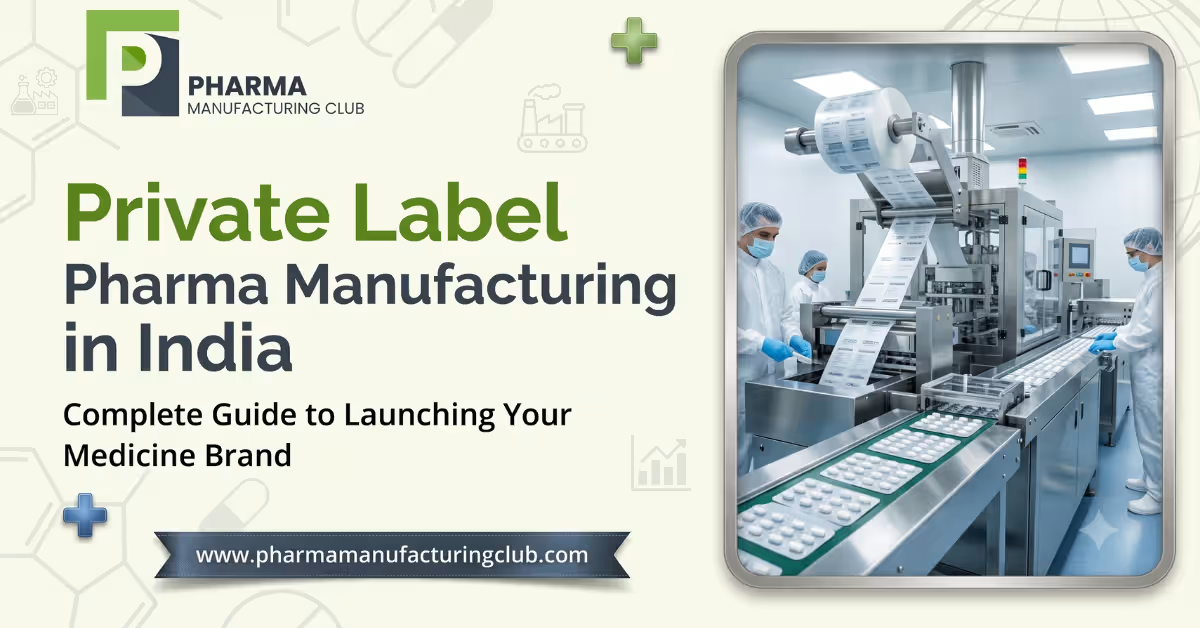
Private label pharma manufacturing allows businesses to launch pharmaceutical products under their own brand without establishing a manufacturing facility. A certified pharma manufacturer handles production, quality control, packaging, and related manufacturing activities, while the brand owner focuses on product selection, branding, distribution, and marketing. This model can reduce infrastructure investment and shorten the time required to enter the pharmaceutical market.
What is Private Label Pharma Manufacturing?
Basically, the term private label pharma manufacturing implies the sale of ready-made medicines under your own brand. In this business model, the associated pharma manufacturer owns the plant and the formulations. In the meantime, you have the brand, label, and marketing. What is in this model to assist you? The brand owner does not need to establish its own pharmaceutical manufacturing infrastructure, although applicable licences, registrations and commercial requirements may still apply.
The licensed private label pharma company produces the pharmaceutical products according to the agreed specifications, while the brand owner markets them under its approved brand and labeling arrangement, subject to applicable regulatory requirements.
How Private Label Medicine Manufacturing Works?
Now, we will check work process of private label medicine manufacturing into seven easy steps.
- Brand Owner: To begin with, you are the brand owner. Products, name, and market are your choice. At this point, you concentrate on sales.
- Selection of the Manufacturer: The next thing to do is to select a certified private label pharma manufacturer. Thus, check licenses, manufacturing unit, and previous clients are attentively observed.
- Product Finalization: You then finalize the medicine, dosage form, and formulations. Also, you verify the amount required.
- Packaging Design: At the same time, you design the label, box, and brand appearance. As a result, your product is distinguished on the shelves.
- Manufacturing: The private label medicine manufacturing company then goes ahead to manufacture your medicines in large quantities. It is important to note that this type of drug production, which is a private label, is under strict GMP rules.
- Quality Testing: In addition, every batch undergoes stringent quality tests. Each batch undergoes applicable quality-control testing to verify that it meets established product specifications before release.
- Delivery: Lastly, the private label medicine manufacturer loads products with your name. Then they are on schedule and launch-ready.
Benefits of Private Label Pharmaceutical Manufacturing
In the meantime, new brands are rewarded in various ways by this pharmaceutical manufacturing business model.
Build Your Own Brand
Initially, you sell with your own established brand name. Thus, customers gradually recollect and choose your brand.
Lower Initial Investment
If you have less initial pharma manufacturing investment, you can also avoid expensive plants, machines, and licenses. Thus, keep your start-up very low.
Fast Market Entry
Next, ready formulations assist you in launching very fast. Thus, you grab market share much sooner.
Scalable Business
In addition, the pharma company can add new products without new machines. Your brand, therefore, expands easily along with demand.
Professional Packaging
In the same way, professional private label drug manufacturing come up with clean, safe, and legal packs. Consequently, your products appear high-quality and reliable.
Quality Manufacturing
Manufacturing in compliant facilities helps ensure that pharmaceutical products are consistently produced and controlled according to established quality requirements.
Regulatory Compliance
Lastly, the manufacturer can provide manufacturing-related licences, quality documentation, batch records, certificates, and regulatory support within its scope, while the brand owner must ensure that its own applicable business, marketing, distribution, and product-related requirements are met. So you rest with full pharmaceutical private label services.
Private Label Pharma Manufacturing vs Third Party Manufacturing
| Parameter | Private Label Pharma Manufacturing | Third Party Manufacturing in Pharma |
|---|---|---|
| Business Model | Products are manufactured by another company and marketed under the buyer’s own brand or label. | A pharmaceutical company outsources production to a licensed third-party manufacturer for sale under its brand. |
| Product Formulation | Commonly uses existing or ready-to-market formulations, although customization may be available. | Can involve existing formulations or more customized product specifications depending on the manufacturing agreement. |
| Brand Ownership | The buyer markets the finished product under its own brand name. | The marketing company generally sells the manufactured products under its own approved brand or product identity. |
| Customization | Usually focused on branding, labeling, packaging, pack size, and selected product specifications. | Generally offers broader scope for deciding formulation, strength, dosage form, packaging, batch size, and other specifications, subject to regulatory requirements. |
| Product Development | Faster when selecting products from an existing manufacturer portfolio. | May involve additional product planning, formulation selection, documentation, and production arrangements. |
| Time to Market | Typically faster when ready formulations and packaging options are available. | Can take longer when the project requires customized formulations, packaging, approvals, or larger production planning. |
| Minimum Order Quantity | Often suitable for relatively smaller or standardized batches, depending on the manufacturer. | MOQs depend on dosage form, formulation, packaging, production line, and manufacturer requirements. |
| Initial Investment | Generally lower for businesses selecting established formulations and standard packaging. | May involve higher development and setup costs when extensive customization or larger production volumes are required. |
| Manufacturing Infrastructure | The brand owner does not need to establish its own manufacturing facility. | The outsourcing company can use the infrastructure and production capabilities of a licensed third-party manufacturer. |
| Quality & Compliance | Manufacturing must comply with applicable pharmaceutical licensing, quality, and regulatory requirements. | Manufacturing must be performed by an appropriately licensed manufacturer and follow applicable quality and regulatory requirements. |
| Control Over Production | Generally lower when choosing standard products from the manufacturer’s existing portfolio. | Potentially greater control over specifications, batch requirements, packaging, and commercial terms through the manufacturing agreement. |
| Best Suited For | Startups, new pharma brands, marketers, distributors, and businesses seeking faster brand launches. | Pharma marketing companies, established brands, exporters, and businesses requiring larger volumes or greater product customization. |
| Scalability | Suitable for launching and gradually expanding a branded product portfolio. | Well suited to scaling production volumes and building longer-term outsourced manufacturing relationships. |
| Primary Objective | Launch products under your own brand with minimal manufacturing infrastructure and faster market entry. | Outsource pharmaceutical production while retaining greater flexibility over products, volumes, specifications, and commercial strategy. |
Private Label Pharma Manufacturing vs Contract Manufacturing
| Parameter | Private Label Pharma Manufacturing | Contract Manufacturing |
|---|---|---|
| Basic Concept | A pharmaceutical product is manufactured by another company and marketed under the buyer’s own brand or label. | A company contracts a licensed manufacturer to perform agreed manufacturing activities according to defined product, quality, and commercial requirements. |
| Primary Focus | Brand ownership, faster product launches, and building a marketable product portfolio. | Outsourcing production while defining manufacturing responsibilities, specifications, quality requirements, and supply arrangements. |
| Product Formulation | Often based on existing or established formulations offered by the manufacturer, although customization may be available. | May involve existing formulations, technology transfer, or customized product specifications depending on the agreement and regulatory requirements. |
| Customization | Commonly focuses on brand name, packaging, labeling, pack size, and selected product specifications. | Can provide greater flexibility over formulation, manufacturing process, specifications, packaging, testing, and production requirements. |
| Branding | The finished product is marketed under the buyer’s own brand. | The branding arrangement depends on the contract and applicable regulatory approvals; manufacturing may be performed for another pharmaceutical company’s products. |
| Manufacturing Control | The brand owner generally has less involvement in day-to-day manufacturing when selecting standard products. | The contract can define detailed requirements for production, quality control, testing, documentation, and other manufacturing activities. |
| Time to Market | Usually faster when established formulations and standard packaging configurations are selected. | May require more time when technology transfer, product development, validation, customization, or detailed contractual arrangements are involved. |
| Initial Investment | Generally suitable for businesses seeking lower product-development and infrastructure investment. | Costs vary significantly and may be higher for customized formulations, development work, validation, technology transfer, or specialized production. |
| Minimum Order Quantity | Often suitable for standardized commercial batches, with MOQ determined by the manufacturer and dosage form. | Batch sizes and minimum volumes are negotiated according to production technology, capacity, product type, and contractual requirements. |
| Quality Responsibilities | The licensed manufacturer must manufacture products in accordance with applicable quality and regulatory requirements. | Quality and manufacturing responsibilities must be clearly allocated between the contracting parties under the manufacturing agreement. |
| Regulatory Documentation | Required licences, product permissions, labeling requirements, and other applicable regulatory obligations still apply. | The agreement should clearly establish responsibilities for documentation, production, testing, quality control, records, and product release as applicable. |
| Scalability | Useful for expanding a branded portfolio without establishing an in-house manufacturing facility. | Suitable for scaling outsourced production and developing long-term manufacturing partnerships. |
| Best Suited For | Pharma startups, marketers, distributors, PCD companies, and businesses wanting to launch their own pharmaceutical brands. | Established pharma companies, marketing authorization holders, exporters, and businesses requiring defined or customized manufacturing capabilities. |
| Key Business Advantage | Enables faster brand expansion without investing in a pharmaceutical manufacturing facility. | Provides access to external manufacturing expertise, capacity, technology, and infrastructure under defined contractual terms. |
| Ideal Objective | Build and market your own pharmaceutical brand with outsourced production. | Outsource manufacturing while maintaining contractually defined control over product, quality, production, and supply requirements. |
Who Can Start a Private Label Medicine Brand?
So, your question is that who is able to start a private label medicine brand nowadays? Different types of pharmaceutical and healthcare businesses may use private label manufacturing, subject to the licences, registrations and regulatory requirements applicable to their activities.
Pharma Marketing Companies
First, there are pharma marketing companies that sell medicines, but they don’t need to own a plant. Thus, they can easily turn into a pharma company of their own.
Healthcare Startups
There are also new healthcare startups that are launched quickly and do not need heavy funding. Therefore, they penetrate the market rapidly.
Hospital Chains
Next, hospitals distribute their own medicines under their brand. In this way, they increase trust and margins.
Doctors
Healthcare businesses and qualified professionals considering branded pharmaceutical products should first confirm the applicable licensing, ownership, distribution, advertising, and professional requirements for their business model.
Exporters
In addition, branded medicines are provided to numerous countries by the reliable pharma exporters from our country. Therefore, they expand into international markets.
Distributors
There are also pharma distributors who develop their own ranges to gain consistency. Thus, they are less reliant on external brands.
Retail Pharmacy Chains
In the meantime, pharmacy chains carry their own brands. This makes them get higher margins easily.
Wellness Brands
Lastly, wellness companies incorporate supplements and health products. As such, they expand their brand portfolio quickly.
Private Label Pharmaceutical Products You Can Launch
It is now possible to open numerous branded private label pharmaceutical products under a single brand.
- Tablets: Pharma tablets are still the most popular dosage form. Therefore, they are applicable to nearly all therapy segments.
- Capsules: Common oral dosage forms used for powders, granules, oils, and other suitable formulations.
- Syrups: Pharma syrups will be effective with children and adults. As such, they simplify the dosing of frail people.
- Injectables: In the meantime, injectables are used to treat severe and immediate diseases. Therefore, they are required in large quantities by hospitals.
- Ointments: Ointments also cure skin, wounds, and pain. They are, therefore, highly utilised in clinics/medical stores.
- Protein Powders: In addition, protein powders aid in fitness and recovery. Gyms and medical stores are pushing them.
- Nutraceuticals: There are also vitamins and daily health nutraceuticals. This has seen the demand continue to increase each year.
- Ayurvedic Products: Ayurvedic ranges are also appealing to natural-care purchasers. Therefore, Ayurvedic products have high levels of trust in India.
- Veterinary Medicines: Lastly, veterinary medicines cure pets and cattle. So, this segment continues to expand as well.
- Topical products: Creams, gels, ointments, and lotions designed for application to the skin according to the approved formulation and indication.
| Category | Simple Description |
|---|---|
| Tablets | Solid oral dosage forms available across many therapeutic categories. |
| Capsules | Oral dosage forms suitable for various approved formulations. |
| Syrups / Liquids | Liquid formulations produced in different strengths and pack sizes. |
| Injectables | Sterile dosage forms requiring specialized manufacturing facilities. |
| Topicals | Creams, gels, lotions, and ointments for approved topical formulations. |
| Nutraceuticals | Permitted vitamin, mineral, and nutritional formulations. |
| Ayurvedic Products | Products manufactured under applicable Ayurvedic requirements. |
| Veterinary Products | Pharmaceutical formulations intended for approved veterinary use. |
Documents Required for Private Label Medicine Manufacturing
The following are the most important papers that you should have before starting private label medicine manufacturing.
- Trademark: First of all, trademark your brand name and logo.
- Drug License: You should have a valid drug license to sell.
- GST Registration: Then, obtain GST to make billing and tax easy.
- Manufacturing Agreement: Next, enter into a definite contract with your private label medicine manufacturing company.
- Product Approvals: Meanwhile, collect COA, COPP, and stability data.
- Registering Your Company: Lastly, before launching your enterprise, you should register your pharma company.
Always have all the documents prepared in advance to start the private label drug manufacturing.
Estimated Cost of Private Label Pharma Manufacturing
At this point, the estimated cost of private label pharma manufacturing is subject to a number of factors.
Type of Product: First, the tablets are cheaper, and the injectables are expensive. The decision you make determines the amount of money spent.
MOQ: Bigger orders also reduce the manufacturing price per unit. Thus, bulk buying saves a good amount of money.
Packaging: Next, high-quality boxes and labels increase the prices a little. Balance thus prudently gazes at your budget.
Formulation: In the meantime, complicated formulations require additional time and experimentation. Therefore, they are a bit more expensive.
Regulatory Costs: Lastly, licenses, quality testing, and papers impose minor costs. So budget these costs in advance.
| Cost Factor | Estimated Cost / Range |
|---|---|
| Tablets | ₹0.50 – ₹5 per tablet* |
| Capsules | ₹1 – ₹6 per capsule* |
| Syrups / Liquid Products | ₹20 – ₹100+ per bottle* |
| Injectables | Quote-based; typically higher than standard oral solids |
| Minimum Order Quantity (MOQ) | Commonly 500–1,000 boxes for some products; dosage-form-specific MOQs vary widely |
| Standard Packaging | Usually included in or added to the product quotation |
| Custom / Premium Packaging | ₹5,000 – ₹25,000+ for design/artwork and setup* |
| Standard Formulation | Usually incorporated into manufacturing quotation |
| Custom Formulation / Development | Quote-based |
| Quality Testing & Documentation | Varies by product and testing requirements |
| Licensing & Regulatory Expenses | Variable; depends on business model, product category and applicable approvals |
| Typical Initial Budget | Approximately ₹2 lakh – ₹5 lakh for a small multi-product launch* |
How to Choose the Right Private Label Pharma Manufacturer?
But how do you select the appropriate private label pharma manufacturer? Be careful, read these seven points, and sign agreement with a reliable manufacturing partner.
Step 1: Certifications: To begin with, verify WHO-GMP, ISO, and valid licences. Verify applicable manufacturing licences, GMP compliance and relevant certifications. These provide important evidence of the manufacturer’s quality systems and regulatory preparedness.
Step 2: Capacity of Manufacturing: In addition, verify whether the manufacturing plant is able to accommodate your volume. So there is no supply breaking in high demand.
Step 3: Product Portfolio: Next, check their entire variety of dosage forms. In this way, you introduce differentiated products in a row.
Step 4: Packaging: In the meantime, inquire about custom labels and box designs. As a result, your brand appears special and of high quality.
Step 5: MOQ: Check the minimum order quantity (MOQs) also with the private label pharma company. Therefore, small brands can begin without an excessive amount of stock.
Step 6: Quality Assurance: Likewise, ensure strict batch testing at every stage. Consequently, all products remain safe and dependable.
Step 7: Support of Regulations: Lastly, make sure they supply the COA, COPP, and documents. So exports and approvals go easily.
Common Mistakes When Choosing a Private Label Pharma Manufacturer
| Mistake | Why It Matters |
|---|---|
| Choosing Only by Price | The lowest quotation may not provide the required product quality, manufacturing standards, or business support. |
| Not Verifying Licences | Working without verifying applicable manufacturing licences and certifications can create regulatory and commercial risks. |
| Ignoring MOQ | Accepting unsuitable minimum order quantities may result in excess inventory, higher working capital requirements, and potential product expiry. |
| Skipping Artwork Checks | Failure to review labels, cartons, foils, and other packaging artwork can lead to printing, labeling, or compliance-related problems. |
| Not Defining Timelines | Unclear production and delivery schedules can cause manufacturing delays and postpone planned product launches. |
| Weak Manufacturing Agreement | An incomplete agreement may leave responsibilities for manufacturing, quality, documentation, pricing, delivery, and other obligations unclear. |
| Not Checking QA/QC Documentation | Failure to review relevant quality assurance and quality control documentation makes it harder to evaluate manufacturing consistency and product quality. |
Find Verified Private Label Pharma Manufacturers in India
Choosing the right manufacturing partner requires comparing product capabilities, applicable licences, quality systems, MOQ, packaging options, manufacturing capacity and commercial terms. Pharma Manufacturing Club helps businesses discover and compare private label pharma manufacturers in India across different dosage forms and therapeutic categories. Review private label medicine manufacturer information carefully and conduct your own commercial and regulatory due diligence before finalizing a manufacturing partner.
Key Takeaways
- Private label pharma manufacturing allows businesses to market pharmaceutical products under their own brand without establishing a manufacturing facility.
- Manufacturing must be handled by an appropriately licensed facility under applicable quality and regulatory requirements.
- Costs depend heavily on formulation, dosage form, MOQ, packaging and testing.
- Private label medicine manufacturing generally offers faster market entry when existing formulations are selected.
- Manufacturing partner selection should consider licences, GMP compliance, QA/QC systems, and capacity, MOQ, documentation and commercial terms.
- Brand owners should verify their own applicable licensing, distribution, labeling and regulatory responsibilities before launch.
Frequently Asked Questions
What is a private label pharma manufacturing?
Private label pharma manufacturing involves the sale of ready-made medicines under your own brand. In the meantime, an accredited pharma manufacturing company does the manufacturing, testing, and packaging.
How much investment is required?
Typically, the investment in private label medicine manufacturing is minimal. But cost is determined by the type of product, minimum order, and packaging.
Who owns the brand?
In a typical private label arrangement, the buyer owns or controls the brand under which the product is marketed, while the licensed manufacturer produces the product according to the agreed manufacturing and regulatory arrangement.
Can startups use private label manufacturing?
Yes, private label pharma manufacturing can allow startups to launch branded pharmaceutical products without investing in their own manufacturing facility, subject to applicable licences and regulatory requirements.
Is third party manufacturing the same as contract manufacturing?
No, third party manufacturing is in fact a subset of pharmaceutical contract manufacturing services. Nevertheless, control, custom work, and agreements make them distinct.
What is the difference between private label and third party manufacturing?
The use of a private label pharmaceutical company involves ready-made formulas. In the meantime, a third party allows you to make formulations and specs more customizable.
How long does manufacturing take?
Production timelines vary by dosage form, batch size, packaging, artwork approval, raw-material availability, testing, and manufacturer capacity. Ask the manufacturer for a written production and dispatch timeline before confirming the order.
Can exporters use private label manufacturing?
Yes, indeed. Branded medicines are sold by the pharma exporters across the globe, whereas certified pharma manufacturers are the ones who offer complete export documents.
What certifications should manufacturers have?
Notably, it is essential that you always choose WHO-GMP and ISO-certified private label medicine manufacturing company.
How do I choose the right manufacturer?
Check required licenses, manufacturing capacity, and quality procedure of the production partner.